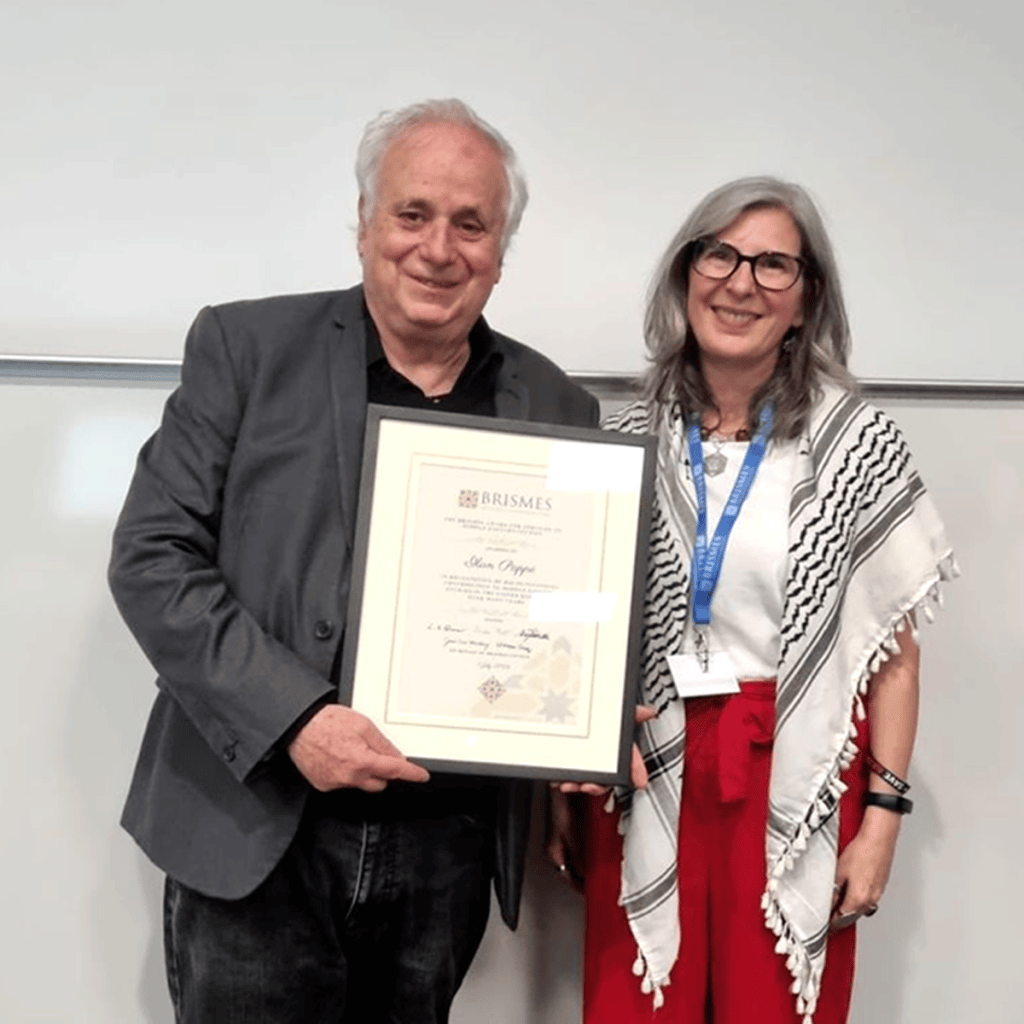
The Pappé Case and the Silent Crisis of Institutions of Knowledge
Anyone who discusses Israel on social media, even only occasionally, knows this scenario all too well: in a conversation with someone firmly aligned with the Palestinian side, sooner or later the name Ilan Pappé comes up — often the only historian that person has ever actually read in full, brandished as definitive proof. Those on the opposite side usually know almost nothing about his work in any detail: they hear the name, recoil instinctively, and retreat behind a joke or a laughing emoji without really knowing why they should object. It would be more honest for both sides to admit it: few of those who cite him, and few of those who despise him, have genuinely read his works with the attention they deserve — for better or worse.
There is one detail in this mechanism worth isolating before even entering the historiographical debate: why does it matter so much that the person saying these things is an Israeli historian? The phrase “even Israeli historians admit it” appears everywhere, and the author’s nationality is not an incidental feature of the argument — it is an integral part of it. When an Israeli makes a statement unfavorable to Israel, it stops sounding like a thesis to be examined and begins to sound like a confession, carrying all the evidentiary weight that a confession implies. It is a rhetorical mechanism that works only in one direction: a Jewish or Israeli historian who confirms the pre-existing framework is welcomed with enthusiasm, as proof that “even one of them” admits it; any other Jewish or Israeli historian who challenges that framework — Anita Shapira, Morris himself when he revised his conclusions in the opposite direction, dozens of others less familiar to the general public — is instead dismissed in advance, branded as an internal voice of a Zionist ideology presumed by definition to be incapable of judging itself. This is not an isolated double standard: it is the same logic of confirmation bias that we will encounter later in the way historical sources are handled — merely transferred from the archival document to the person of the historian, selected or discarded not according to the quality of his work, but according to how closely he confirms what people already wanted to hear.
The phenomenon is so recognizable that in Israeli and pro-Israel online debate it has acquired an ironic label, “AsAJew” — from the formula with which certain commentators begin their interventions (“as a Jew, I…”) in order to lend identity-based authority to a position which, coincidentally, almost always aligns with the most hostile interpretation of Israel currently in circulation. This is not merely a social-media invention: the same logic has a public equivalent in Italy, where figures such as Moni Ovadia receive media attention disproportionate to their actual significance as Jewish voices precisely because they are critics of Israel — their Jewish identity is presented not as one perspective among many, but almost as a moral authorization to say things that, coming from anyone else, would invite greater caution. Pappé does not explicitly employ this rhetoric — the legitimacy he claims for himself is methodological rather than identity-based — but in the way he is publicly used (“even an Israeli historian admits it”), he is treated in exactly the same way: as a star witness summoned to testify against his own community.
It is therefore worth doing, once and for all, the work that is usually missing on both sides: who is Ilan Pappé really? An Israeli historian now at the University of Exeter after leaving the University of Haifa, he has become over the past twenty years the best-known — and most controversial — face of the so-called “New Historians.” This was the group of scholars who, beginning in the 1980s, re-examined the history of 1948 by using newly declassified Israeli archives, correcting quite a few blind spots in a historiography that until then had been rather hagiographic toward the newly founded state.
Among the recurring defenses offered against those who criticize his use and interpretation of sources, there is one that, on closer examination, is rather paradoxical: Pappé applies to Israel the method that should be used when studying colonial powers. In other words, even before research begins, Israel is to be viewed through a lens that already reveals a bias. It assumes as already established what serious historical research ought instead to demonstrate or disprove — namely, that Israel is a “colonial power.” If it is colonial by definition from the outset, then every Israeli source must be read with systematic suspicion, as the archive of a colonial administration that conceals and lies. Yet this is precisely where the assumption collides with a verifiable fact, and a rather inconvenient one for those who make it: colonial administrations, by definition, do not open their archives to the critical scrutiny of those who study them — they keep them closed, filter them, destroy them. Israel did the exact opposite: after several decades it made large portions of its state, military and diplomatic archives public — and it was precisely this opening that made the work of the New Historians possible, Pappé included. The corresponding archives of the Arab countries involved in 1948 have, in the great majority of cases, remained closed or far less accessible. The paradox is therefore twofold: not only is the colonial framework assumed rather than demonstrated, but it is assumed precisely in relation to the one side in the conflict that made itself transparent — while the other side, by failing to open its archives, remains beyond the reach of the same kind of scrutiny and, curiously, also beyond the reach of the same suspicion. If Israel is not colonial — or if colonialism is simply one hypothesis among others, still to be tested — then that assumption should be stated and argued for, not silently built into the methodology as though it were already an established fact.
An Internal Rift, Not One Between “Zionists” and “Anti-Zionists”
Consider one of the most consequential areas of Pappé’s research: the Palestinian refugees of 1948. From the outset, Pappé argued for exclusive Israeli responsibility, presenting the refugee crisis as the result of a deliberate plan of expulsion. The same group of historians to which he belonged — including Morris and Segev — instead distributed responsibility for the displacement of the Arabs among the various parties involved.
What is striking, on closer inspection, is that Pappé was not criticized primarily by the Israeli establishment, but by the very historians closest to him: Benny Morris, Avi Shlaim and Tom Segev shared his basic project — using Israeli archives to correct a historiography that had been overly lenient, if not openly hagiographic, toward that historical period.
With the Second Intifada in 2000, that interpretative divergence became a personal and institutional rupture. It is significant — and intellectual honesty requires us to say so, because it complicates any tribal reading of the issue — that Morris himself moved toward increasingly hard-line positions, eventually expressing public regret that the expulsions of 1948 had not been more complete. The “New Historians” were never a monolithic bloc: they divided, and that internal division is perhaps the best evidence that the dispute over Pappé is not simply trench warfare between predetermined political factions, but a question concerning the method with which each of them handled the same sources.
And it is precisely on this ground — methodology — that Pappé receives the harshest criticism, not from convenient ideological opponents. Morris himself dismissed his work as “ideology masquerading as history.” Pappé has been criticized in particular for his selective use of certain documents — the minutes of the so-called “Transfer Committee,” whose authenticity other historians have questioned — treating them as decisive evidence when they confirm his thesis, and for his tendency to construct clear-cut narratives stripped of the complexities acknowledged by the very New Historians who were once closest to him.
The Real Problem Is Not Pappé
It would be a mistake, however, to reduce all this to a scholarly dispute over a single historian, influential though he may be. The Pappé case is useful precisely because it is a textbook case — literally so: it makes unusually visible a mechanism that is quietly reproducing itself throughout entire sectors of contemporary academic knowledge.
The mechanism works like this: an interpretative framework — whether “settler colonialism,” a gender theory, or any other conceptual lens — ceases to function as a hypothesis subjected to verification and becomes a non-negotiable assumption. At that point, sources that confirm it are accepted, while those that complicate it are bypassed, or their authenticity is questioned only when necessary. This is not necessarily conscious dishonesty: it is what might be called structural confirmation bias, built into the methodology of an entire field of study rather than merely residing in the mind of an individual researcher.
How, however, does an entire academic field reach the point where it stops noticing this? Not through conspiracy, but through the convergence of several mechanisms, all of them observable and none of them, taken individually, particularly scandalous.
First: the concentration of interests. In every academic community, quality control is never exercised by everyone, but by a small number of structural nodes: hiring committees, editorial boards, committees allocating doctoral places and research funding. It is worth getting some sense of the actual scale involved, because people outside academia rarely realize it: a humanities department at a medium-sized university will generally have somewhere between twenty and forty permanent faculty members, alongside a far larger population of doctoral students, postdoctoral fellows and contract researchers — an army of collaborators whose future depends, year after year, on the judgment of those above them, and who therefore have every reason to avoid taking risks. Yet the decisions that truly matter — who gets hired, who gets published, who receives funding — almost always pass through the hands of very small committees, often no more than three or five people at a time. A few dozen people in each subfield decide who gets in, who publishes, who gets funded — and this is true even under perfectly healthy conditions, because someone has to make those judgments. The problem begins when, among the many scholars who make up a field, a small group shares an explicit agenda and has a very strong interest in occupying precisely those few decision-making nodes, while the majority — simply busy doing their work, without a common project to defend — has no comparable reason to seek committee positions, attend meetings or draft guidelines. There is no need to imagine a conspiracy: the difference between people with a declared, organized objective and people who simply do not have one is enough. It is the same mechanism by which, in so many organizations — not only academic ones — a small and highly motivated committee manages to steer decisions affecting hundreds of otherwise indifferent people: not because it is stronger, but because it is the only group that bothered to show up.
The mechanism becomes even stronger when one of those few nodes is occupied by someone endowed with personal charisma as well as formal power — the professor who founded the department, the “senior scholar” everyone cites, the person whose word carries more weight than a vote on a committee because nobody wants to be remembered as the one who opposed him, and who may also happen to be capable of securing research funding that other departments can only dream of. In such environments, charisma is often fed by credentials no one else can claim: imagine, for example, a professor who spent years training in a country such as Iran, credentials that can then be presented as unrivalled authority on the entire Middle East — regardless of the fact that the same training took place within a system whose official apparatus has for decades literally described the United States and Israel as the Great Satan and the Little Satan. No one asks what worldview may have been absorbed alongside the language and texts studied in such an environment: the exotic credential works on its own as a passport to authority, irrespective of the ideological content it may silently carry with it. In Pappé’s case, it is the same decolonial and anti-Zionist agenda — one that has acquired increasing influence in Anglo-American Middle East Studies over recent decades — that has every incentive to promote precisely those works that confirm its interpretative framework. And it is for the same reason that, as we have already seen, a Jewish or Israeli author who conforms to that agenda is promoted and cited with an intensity disproportionate to the intrinsic value of his work: his identity makes an already accepted thesis even more publicly marketable.
Second: homophily in recruitment. Once those nodes have been occupied, what conforms to the group’s objectives begins to be filtered from what does not. In a faculty dealing, for example, with Middle Eastern studies, this means that some theses, people and projects are favored while others are not. Yet the confrontation is rarely direct or explicit: work that shares the assumptions of those doing the judging is simply received as “more rigorous,” “more up to date”; work that challenges them appears naive or outdated. It is almost always settled with a no delivered with a smile, somewhere between pity and reproach — and anyone who has tried understands, without needing to be explicitly told, that trying again is probably not advisable. In such an environment, even without verbal or physical aggression, how long can a Jewish professor who refuses to conform survive, or a student who naively tries to bring the ball back to the center of the field simply because he has discovered things nobody is talking about? It becomes a form of implicit antisemitism that, in practice, nobody can formally challenge: how do you report a professor who eliminates you with a smile, telling you that your bibliography is not authoritative or is now outdated? There is no discriminatory sentence to bring before a disciplinary office, no specific action that would stand up before a committee — there is only an academic judgment, formally impeccable, which nevertheless produces the same result every time. This is precisely what has happened, in the field of Middle East Studies, to works such as Pappé’s: within the space of a generation they have become standard references in doctoral programs, obligatory citations in new articles, points of departure treated as established rather than hypotheses among others to be tested — while historians who oppose him on substantive grounds, beginning with his own former fellow travelers such as Morris, are relegated to a minority or “outdated” position within the same field that once trained them together. Every cycle of hiring, every new doctoral program, every journal deciding what to review slightly reinforces this composition, in a cumulative process that over the span of one academic generation — fifteen or twenty years — can transform an entire department without a single openly ideological act: it is enough that, year after year, new hires are more likely to share the framework than to question it.
Third: preference falsification. Political scientist Timur Kuran has described how, where the social cost of public dissent is high and the potential benefit negligible, people cease publicly expressing judgments that they continue to hold in private. A doctoral student or precariously employed researcher who senses a methodological problem has everything to lose and nothing to gain by raising it in a committee or in peer review. The result is a spiral of silence: each person believes himself isolated in his doubts because nobody else expresses them, and apparent consensus feeds upon itself even when actual consensus is far more fragile than it appears.
Fourth — and the most subtle: the redefinition of rigor itself. No one says any longer, “your thesis is weak because it does not share our assumptions.” Instead, one says it is “methodologically naive,” that it “ignores the most recent scholarship” — when that scholarship is, by construction, produced by those who already control the process of judgment. Dissent is not refuted on its merits: it is reclassified as technical incompetence. This is far more effective than explicit censorship, because it never presents itself as coercion — it presents itself as merit, as the natural development of the discipline. And precisely for that reason it is more difficult to denounce: there is no single act of censorship to point to, only a pattern of outcomes that can always be disputed case by case.
Taken together, these four mechanisms produce an effect that goes well beyond the individual injustice suffered by a particular researcher who has been passed over: they undermine the very possibility of doing research. It is worth being precise about what that means, because the point is easily missed: the purpose is not to ensure that every thesis reaches the “correct” conclusion, still less the conclusion the researcher would have preferred to reach. The purpose is to ensure that the method has been applied correctly, regardless of what conclusion it produces. A doctoral thesis does not certify that the student has said something everyone should agree with — it certifies that the student has demonstrated mastery of the methods of his discipline, whatever subject he has chosen to investigate. And this is why a thesis remains, by definition, open to refutation: not because everyone has to like it, but because refutation can occur only within the same methodological framework — one disputes whether the method has been applied correctly, not whether the conclusion is welcome.
When this principle collapses — when judgment ceases to concern method and begins to concern alignment — what is lost is not merely a degree of rigor: what is lost is the very possibility of scholarship in the proper sense of the word. What remains in its place is an elegant way of asserting an opinion, supported not by a verifiable method but by the nodes of power that manufacture and protect the consensus surrounding it. And there is a paradox here, if one thinks about it: this is precisely the danger into which contemporary academia risks falling. The modern university emerged and legitimized itself as an overcoming of the medieval scholastic logic according to which a thesis was true because it was upheld by constituted authority, rather than because it could be demonstrated through a verifiable method. When academic judgment is reduced to “it is rigorous because those who control the consensus say it is,” we have not escaped that logic at all — we have simply dressed it in critical and progressive language, while remaining, in substance, a caricature of what we imagine ourselves to have overcome.
An example from a field apparently very far removed from the Pappé case may help show that this is not a problem peculiar to Middle Eastern historiography: even in a discipline such as biblical exegesis, I cannot make a text say whatever I want it to say, whatever I might need it to say in order to support a thesis that may perhaps be useful, perhaps even admirable in its intentions. I have to be honest with the text and say only what that text, in its language and context, actually allows me to say. There is a principle of intellectual honesty without which there can be neither method, nor scientific discipline, nor academic debate. There is only dogma, and the power required to impose it.
Ultimately, the real criterion does not change from one field to another: a thesis deserves to be called an academic contribution only if it remains exposed to the risk of being disproved by someone who disagrees with it. When that risk disappears — when the framework ceases to be a hypothesis and becomes dogma — the university has not produced new knowledge. It has produced the scholarly staging of a conclusion already written somewhere else.
Conclusion
We are therefore left with the question from which, in the end, we began: what value does Pappé really have for someone who wants to understand the modern history of Israel? The honest answer, after following this path, is neither that of those who cite him as definitive proof nor that of those who dismiss him without ever having read him. Pappé must be credited, together with the other New Historians, with having been among the first to subject the newly declassified Israeli archives to a less hagiographic reading — something that, on the historical level, even his harshest critics, Morris foremost among them, acknowledge. Yet that achievement concerns access to the sources, not the way those sources were subsequently used: from a certain point onward, his work ceased to interrogate them in order to construct a thesis and began instead to select them in order to confirm an interpretative framework — that of settler colonialism, borrowed from Said before being tested against the documents themselves — which had already been decided before the research began. At that point, he is no longer a historian following the sources wherever they lead: he becomes a case of confirmation bias, however sophisticated and well written. His works should therefore be approached with this awareness — useful for understanding how a particular debate arose and what questions it raised, but unreliable if treated as an already demonstrated conclusion rather than as one partisan thesis among others.
Anyone who cites him as an oracle commits precisely the same error that this entire article has sought to dismantle. You can brandish him as in the photograph, a handsome book with its cover prominently displayed, only to have it hurled back at you by a shouting crowd. And anyone who despises him without ever having opened one of his books simply has no grounds for claiming to be informed on the subject.
The point, ultimately, is simple, and it is the same one repeated throughout every line of this article: an author is not accepted or rejected because he is Jewish, or because he is anti-Zionist and anti-colonialist. You open the book. You take the individual pages, the individual arguments, the individual theses, and compare them with what others have written on the same subject. Anyone who wants to produce serious work of genuine academic value goes back to the sources and — while freely stating, perhaps in a preface, his own point of view — weighs the arguments of others with intellectual honesty, examining what the available sources actually allow us to say, setting aside what they do not support, identifying the problems that emerge, the evidence that confirms particular claims, and the questions that still require further investigation. All of this should rest on a solid bibliography and ultimately be published in order to enter into a debate among peers, using the same methods that the discipline demands of everyone else.
Ilan Pappé is not, for the present author, a point of reference in the historiography of Israel — but explaining why he has become one for others, and at what methodological cost, was the real subject of this article. In other words, he is not the “final boss”: he only becomes one for those who stop reading before they reach the end.


Rispondi